

Teresa Schlabach’s favorite aspect of her work is when the viewer has to stop to do a double-take.
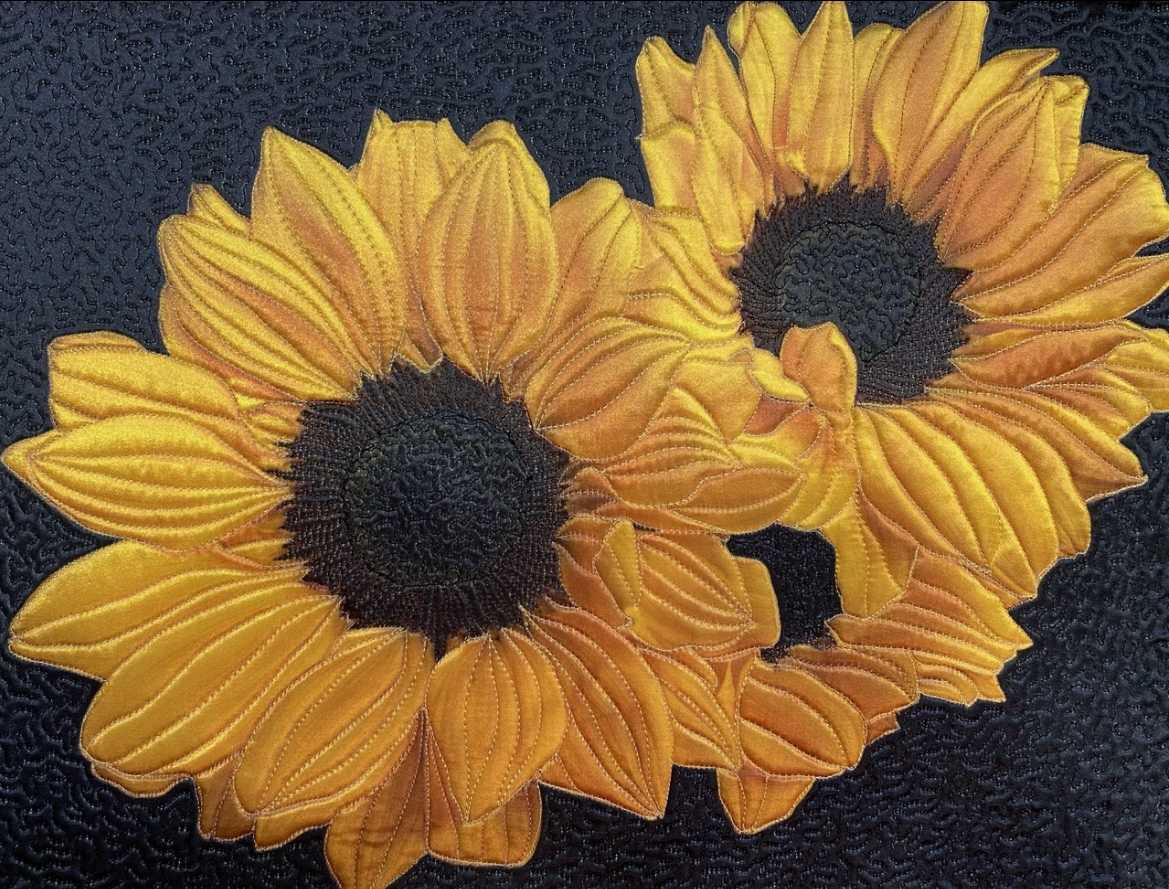
“Wait, what is that?” or “I thought that was a painting,” some may say.
Schlabach calls her work “thread painting.” Her sewing machine is her brush, her thread is her paint and fabric is her canvas.
Schlabach said she developed her art as a way of branching her aptitude for photography with her love of sewing.
She begins by taking a photo of her subject, which is often flowers.
“My favorite subjects are florals. I love florals … I’m a huge sunflower lover, so I will get a sunflower. Usually, I have to order one from the florist because the ones I really love are a red-orange sunflower with a purple growth underneath. They are only grown in Ecuador.
“What I want my viewer to see is a different view or a different angle of that flower than what they normally are used to.”
Schlabach said to find her interesting angle she will take between 50 and 80 shots of the flower in different poses.
Once she gets the desired photograph of her subject, Schlabach will then print her photograph onto fabric.
“When you print on fabric, ink bleeds, which is great for a background but for your focal point, that’s not so good, so somehow I need to get those details back in. So, I sandwich the whole thing up like a quilt … and then I will go back in and what they call ‘free motion stitch’ the details back in, which means that basically you’re drawing with your sewing machine.
“What I like to do is set up the photo on my iPad so I see that as a reference as I go back in and stitch those details into that photo,” she said.
“Being put together like a quilt gives them a 3D effect, so it gives it dimension and I’m a big dimension person. I really like dimension in art.”
Schlabach said that she has also been collaborating with dye and sketch artist Michael Rowland.
Schlabach said in the projects she does with Rowland, they will sketch a landscape, dye the fabrics, cut and arrange the pieces of fabric like a quilt and then stitch the pieces together.
Schlabach also dabbles in functional pieces.
“A lot of people like to have a piece of art but maybe they don’t have wall space. They need something small.”
Schlabach said that she often makes decorative accent pillows and has also made luxurious clutches suitable for weddings or galas.
In each of her projects, Schlabach takes careful consideration into which fabrics she uses. For more functional pieces she chooses more durable fabrics.
Schlabach said that all fabrics take dye differently, so she has to pick her fabrics carefully when considering which colors she wants in her pieces.
She has been thread painting for the past nine years, and she said getting into the craft was a process.
Growing up, she said both her mother and father sewed.
“They sewed all our clothes, they sewed our Barbie clothes, all that kind of stuff. My mom got frustrated trying to teach me how to sew, so she took me to a 4-H program one summer.”
“So I started sewing when I was 10. I’ve been sewing for over 50 years and absolutely I just fell in love with it.”
Despite her love for sewing and eventually photography, Schlabach said that she received her degree in mass communications in radio and television production with a minor in business, but her love for the arts was persistent.
She went on to become the executive director for the Alma Performing Arts Center — now known as the Skokos Performing Arts Center -— for 20 years.
“It was run by a foundation that I built and we brought in entertainment to raise money for scholarships for kids that graduated from our area because we did not have a foundation at that time,” she said.
During her work for the performing arts center, her interest in bridging her love of photography and fabric art grew. She eventually discovered who would become her greatest influence for her work — Jane Hartfield.
After being inspired by Hartfield’s fabric art, Schlabach decided to reach out, which led to Hartfield inviting Schlabach to her studio.
“I told her I wanted to learn to combine my photography with my sewing skills and I had no idea how to do that, and so she mentored me for two years and she made me try different things. She dragged me all over and she said ‘You need to see this lady,’ ‘You need to look at this,’ ‘You need to see this.’”
“So finally I got to the point where I was like, ‘OK, I’m gonna try to see if I can stitch a giraffe … She said ‘What’s the worst that can happen? You throw it away. No big deal. It’s a piece of fabric.’ So I did, and it actually worked. I was like, ‘Oh, this works. I think I can do this.’”
Schlabach said that Hartfield’s willingness to help her discover her niche in the fabric medium despite her and Hartfield’s work being very different, made her “one in a million.”
Schlabach said that she recently retired to focus on her thread painting, which she has now been doing for nine years.
Schlabach has since been working with quilting guilds to help them learn to integrate technology into their quilting.
“I think it’s great and it’s a learning curve for some people, especially people that are traditional quilters and maybe didn’t grow up with computers, maybe don’t understand how to use them or how to upload an image, so it’s fun. I love talking to people about that and showing them how this can work.”
Schlabach is currently working on a new series titled “Elegant Dying” which involves the daily photographic study of decaying flowers.
Schlabach’s work can be found in Studio 34 in Eureka Springs as well as on her Etsy page, @TeresasThreadStudio.
Schlabach will also display her art at the Garland County Master Gardeners in Hot Springs in the spring.